
SNA Chapter Resource Guide
The Florida Nursing Students Association (FNSA) requires school chapters to maintain dual constituency with both the National Student Nurses’ Association (NSNA) and the Florida Nursing Students Association (FNSA), which operate as separate entities administratively.
Chapters must meet both national and state requirements to remain active and eligible for representation, voting privileges, awards eligibility, and participation in state and national governance at the House of Delegates.
School chapters are separate entities from FNSA in daily operations. FNSA does not supervise chapter daily activities but requires compliance with state bylaws.
How to Start a Chapter
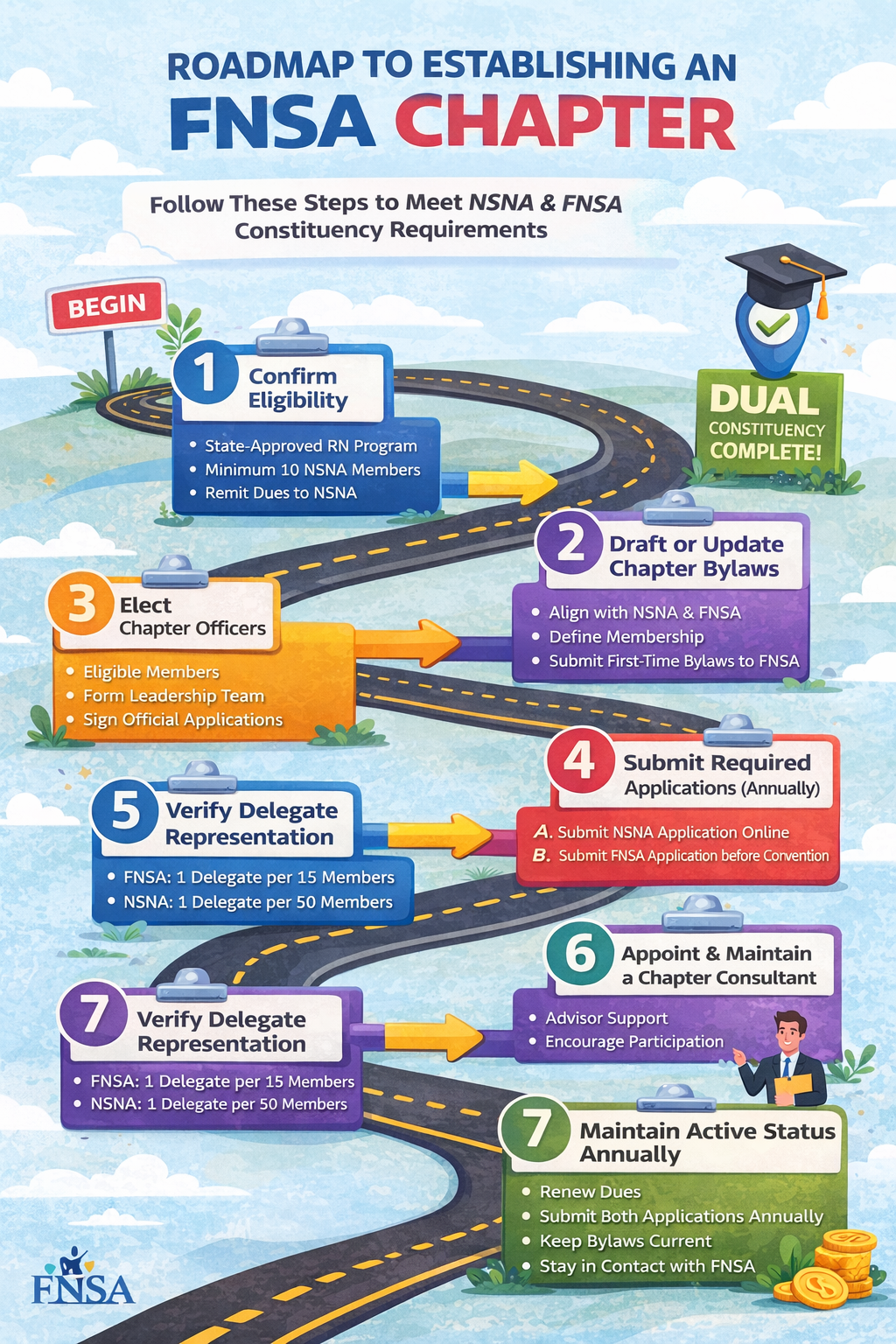
-
• State-approved RN program
• Minimum 10 active NSNA members
• Dues remitted to NSNA
• Members in good standing -
Bylaws must:
• Align with NSNA Areas of Conformity
• Align with FNSA Bylaws
• Define membership eligibility
• Define delegate selection process
• Define officer roles
• Define local dues (if applicable)First-time chapters must submit bylaws to FNSA with their application.
-
• Officers must be members in good standing
• Officers sign official applications
• Faculty cannot sign on behalf of students -
• Submit online annually
• Required before National Convention
• Required before delegate credentialing• Submit annually
• Due 2 weeks before FNSA Convention
• If not attending: submit within 10 working days after Convention closesBoth applications are required to maintain active status.
-
FNSA Convention
• 1 delegate per 15 members
• Membership calculated 25 days before conventionNSNA Convention
• 1 delegate for first 50 members
• +1 delegate per additional 50 membersDelegates must be credentialed to vote.
-
Consultant responsibilities include:
• Advisory support
• Communicating state/national updates
• Assisting with bylaws maintenance
• Encouraging participation at conventions -
To remain compliant:
• Maintain minimum membership
• Renew dues annually
• Submit both applications annually
• Keep bylaws current
• Maintain communication with FNSA Regional Director
• Participate in House of DelegatesFailure to comply may result in removal of constituency status.
Still Have Questions?
Contact:
• Your FNSA Regional Director
• FNSA First Vice President
• Visit www.nsna.org
Starting a chapter is achievable when you follow the compliance steps carefully and communicate early with state leadership.
-
To establish constituency, your school must have a minimum of ten (10) active NSNA members.
Recommended steps:
• Host an informational meeting explaining the benefits of FNSA and NSNA membership
• Share the NSNA website link for membership enrollment
• Clearly explain dues and what they cover
• Promote leadership, delegate eligibility, and scholarship opportunities
• Work with faculty to announce membership during class timeStudents join directly through NSNA by submitting membership and dues. NSNA verifies active membership.
-
Bylaws must align with:
• NSNA Areas of Conformity
• FNSA BylawsTo begin:
• Request NSNA bylaw templates through NSNA’s Start-a-Chapter resources
• Contact the FNSA First Vice President for state alignment guidance
• Review the FNSA Bylaws to ensure conformityFirst-time chapters must submit a copy of their bylaws with their FNSA Official Constituency Application.
Do not draft bylaws without reviewing both national and state requirements first.
-
You should notify FNSA early in the formation process.
Recommended contacts:
• Your FNSA Regional Director
• The FNSA First Vice President (for bylaws and constituency questions)
• The FNSA President if additional guidance is neededFNSA can:
• Review your draft bylaws
• Confirm deadlines
• Answer application questions
• Provide convention guidanceEarly communication prevents compliance delays.
-
While timelines vary, here is a suggested 90-day launch plan:
Month 1
• Recruit interest group
• Identify faculty consultant
• Begin membership recruitment
• Request bylaw templatesMonth 2
• Finalize bylaws
• Reach 10 active NSNA members
• Elect officers
• Submit NSNA applicationMonth 3
• Submit FNSA application
• Prepare for delegate representation
• Establish communication with Regional DirectorIf starting near convention season, confirm application deadlines immediately.
-
Your first meeting should:
• Review the purpose of forming a chapter
• Confirm at least 10 active NSNA members
• Present and vote to adopt bylaws
• Elect officers according to bylaws
• Document meeting minutesMeeting documentation should include:
• Date
• Attendance
• Motion to adopt bylaws
• Election results
• Officer acceptanceMaintain these records for future verification if requested.
-
Yes. While not required for application submission, a consultant is strongly recommended for sustainability and communication.
Consultants:
• Serve in an advisory capacity
• Assist with maintaining compliance
• Disseminate state and national information
• Encourage participation at conventions
• Support long-term continuitySelecting two consultants from different student levels is recommended when possible.
-
Failure to:
• Submit NSNA application
• Submit FNSA application
• Maintain minimum membershipMay result in loss of constituency status.
Constituent associations not complying with bylaws may be removed by a two-thirds vote of the FNSA Executive Board with due notice.
If you anticipate a delay, contact FNSA immediately.
-
No. School chapters operate independently in daily activities. However:
• Bylaws must align with state and national standards
• Annual applications are required
• Membership compliance must be maintainedFNSA and NSNA do not manage daily operations but require adherence to bylaws for official status.
-
A chapter is fully recognized when:
• It has submitted the NSNA Official Application
• It has submitted the FNSA Official Application
• It maintains minimum membership
• It remains in good standing with dues and bylawsDual constituency allows:
• Voting at state and national conventions
• Award eligibility
• Delegate seating
• Official recognition